Are Learning Styles Real?
July 17, 2026
The 10,000 Hour Rule Is Wrong (The Truth Is Better)
July 28, 2026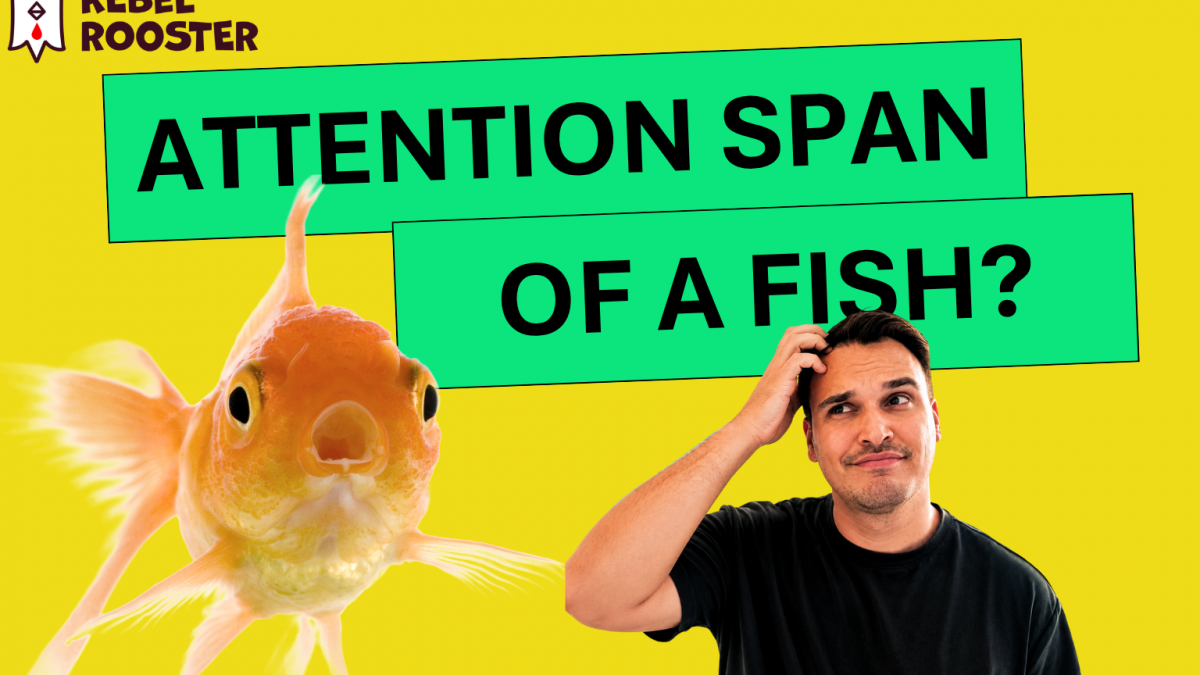
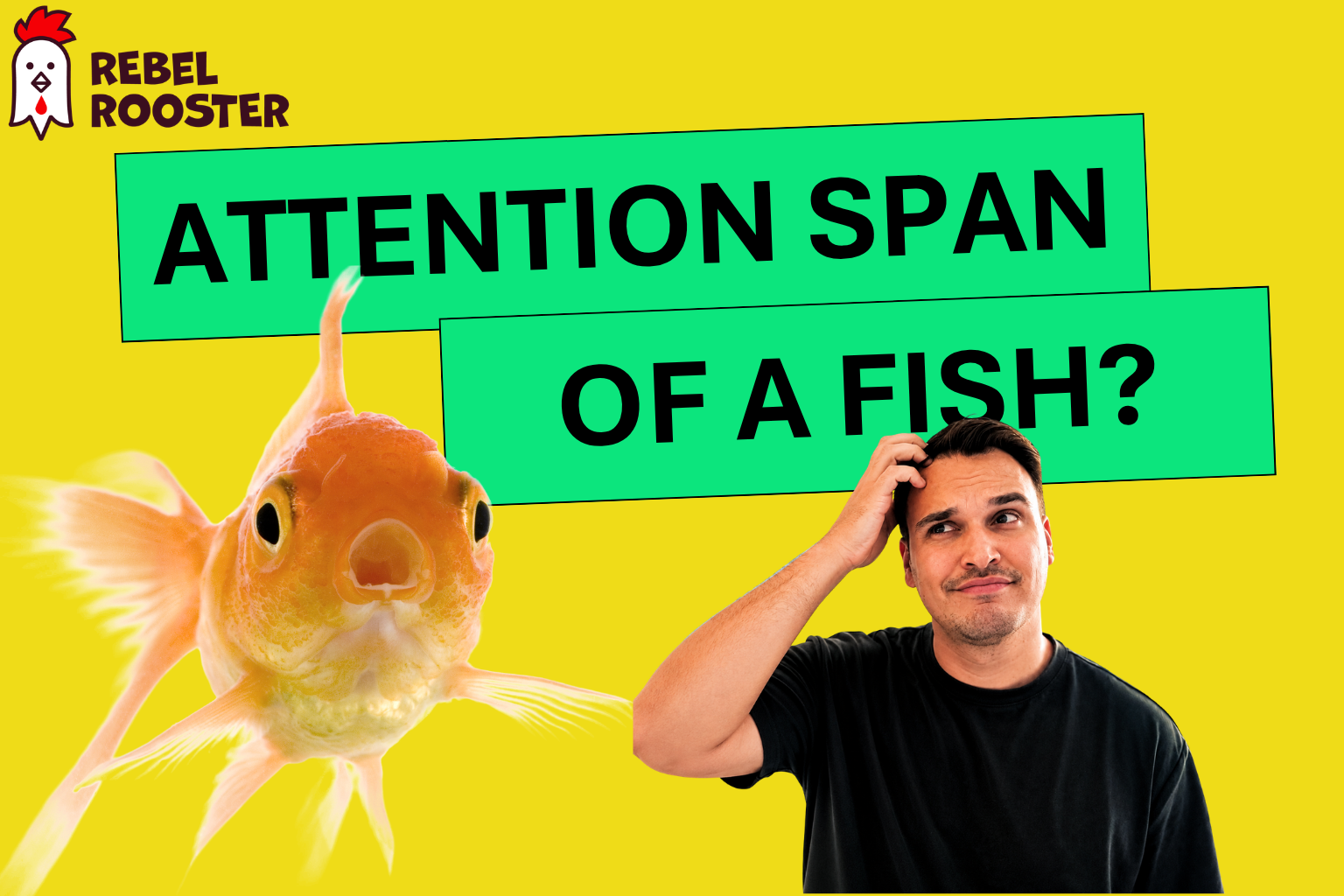
The goldfish attention span myth, and what's actually happening to our focus
By John Lee, Co-Founder, Rebel Rooster
Chances are, you have heard this statistic. In fact, you may have said it. I certainly have.
The average human attention span has fallen to eight seconds, down from twelve at the turn of the century, which makes us officially worse at paying attention than a goldfish, who manages nine.
It's a wonderful little fact. It's neat, it's a bit funny, it flatters the person saying it and gently shames everyone else, and it confirms something we already half-believe about the modern world, that our phones are melting our minds and the kids are the furthest gone. It has been quoted in Time, the New York Times, the Telegraph, the Guardian, on the radio, in management books, in a thousand marketing decks, and, I'm sorry to say, in more than one meeting I've sat in.
It is also completely made up - both numbers. Ours and the fish's. And the story of where it came from, once you follow it, is a small parable about how we think, what we choose to believe, and why a comforting story will always beat an inconvenient truth.
Following the number back to its source
The stat gets attributed, almost every time, to "a 2015 Microsoft study." That attribution is doing a lot of work, because Microsoft sounds like a laboratory, and a laboratory sounds like science.
The Microsoft report is real. It exists. It was a 52-page document produced in 2015 by the consumer-insights team at Microsoft Canada, and it was about marketing, not neuroscience. Somewhere inside it was an infographic, and the infographic contained the now-famous claim: human attention down to eight seconds, one below the goldfish.
Here is the first crack. That headline number wasn't a finding of Microsoft's own research. It was lifted into the infographic from an outside source, credited in small print to a company called Statistic Brain.
So the BBC's Simon Maybin, in 2017, did the thing almost nobody who quoted the stat had bothered to do: he followed the citation. He contacted Statistic Brain and asked them where the number came from [1]. Surprise surprise...they couldn't tell him. The sources they eventually pointed to didn't contain the figure, didn't mention goldfish, and in some cases didn't appear to exist in any checkable form. The trail simply ran into the sand.
And the goldfish half is, if anything, worse. Because there is no study...nobody has ever measured the attention span of a goldfish and arrived at nine seconds, because "the attention span of a goldfish" isn't a thing anyone has meaningfully quantified. The number was invented to give the human figure something humiliating to sit beside. If you're old enough, you'll remember the original folk version of this was about goldfish memory lasting three seconds, which is also false, since goldfish can be trained and remember things for months. The factoid simply mutated from memory to attention because it needed to, to make its point.
So what we have is a fabricated human number, propped up against a fabricated animal number, laundered through a real company's marketing report, and then repeated for a decade by serious people in serious publications, none of whom checked, because it sounded right.
Why nobody checked, which is the actually interesting bit
This is the part I find genuinely philosophical, and it's bigger than attention spans.
The goldfish stat spread not despite being unverified but because it was so satisfying that verifying it felt unnecessary. It slotted perfectly into a story we were already telling ourselves. Technology is doing something to us. We are becoming lesser, shallower, more distractible versions of the people we used to be. The young are the warning sign. Everything is speeding up and thinning out.
That story is old, and much older than the phone. Socrates worried that writing would ruin memory and give people the mere appearance of wisdom. The printing press was going to drown the mind in trivia. The novel would rot the concentration of young women. Radio, cinema, television, video games, each arrived to the same funeral announcement for human attention, and each time the announcement felt completely true to the people making it.
The goldfish is just the latest verse of a very old song, and the reason it travels so well is that it tells us we were right to be worried. It requires no evidence because it isn't really a claim about the world. It's a claim about how we already feel, dressed up in a number so it can be said out loud in a professional setting.
Which is worth sitting with for a second, because if a fake statistic can circle the globe for ten years purely on the strength of confirming what we suspected, that tells you something uncomfortable about how much of what we "know" is actually just stuff that felt true and never got checked.
What's actually happening to attention
Now, here's where I have to be honest, because it would be easy and cheap to end on "so relax, your attention is fine, it was all a myth." That's not quite true either, and pretending otherwise would make me as lazy as the people who quoted the goldfish.
Something real is going on, but it's not the thing the myth claims.
Attention isn't a single dial that's being turned down. Psychologists distinguish between different kinds: the ability to focus deeply on one demanding thing, the ability to filter out distraction, the ability to switch between tasks. And human beings are as capable of deep, sustained focus as they ever were. The evidence for the underlying capacity being intact is right in front of us: the same people supposedly reduced to eight seconds will happily disappear into a six-hour game, a whole season of a show in a weekend, a novel, a craft, a spreadsheet they actually care about. The hardware is fine.
What has changed is the environment, and how we deploy that hardware inside it.
Gloria Mark, a professor at UC Irvine who has studied attention on screens since 2004, has tracked something striking. The average length of time a person spends on a single screen before switching has collapsed, from around two and a half minutes two decades ago to roughly 47 seconds now [2]. That of course is a real measurement of a real change. But it is not a measurement of a shrinking attention span. It's a measurement of an environment engineered, deliberately and very profitably, to interrupt us. Notifications, feeds, autoplay, the little red dots, all of it designed by people far cleverer and better funded than the person trying to concentrate, and all of it pulling in the same direction.
So we haven't lost the ability to pay attention. We've been trained, by an environment that monetises our distraction, to give our attention away more readily, and to become far pickier about what earns it in the first place. That's a different diagnosis, and it matters, because it points at a different cure. You don't fix a fragmented environment by dumbing down the thing you're asking people to focus on.
You fix it by being worth focusing on.
What this means for anyone trying to teach or communicate
This is where the myth stops being a fun bit of trivia and starts costing organisations real money, because the goldfish stat is used, constantly, as an excuse.
I have lost count of the number of times I've been told that training has to be shorter, thinner, choppier, dumbed down and sped up, because the modern learner, and especially the young one, simply can't cope with anything longer. Attention spans, you see. Goldfish. And so a genuine, careful, meaty piece of learning gets chopped into confetti on the assumption that nobody could possibly sit with it.
When I put this to Professor Joe Devlin, a cognitive neuroscientist at UCL, for our recent whitepaper, he was blunt about the generational version of the myth in particular:
"The idea that these Gen Zedders are somehow deficient because they grew up digital native... that's just not true. That's just a myth."
What actually governs attention isn't age and it isn't some dwindling biological allowance. It's context and investment. Catch someone cold at the top of a feed and yes, you've got a second or two before they scroll, because they've made no commitment to you and the environment has trained them to keep moving. But that exact same person, having decided to sit down and watch something they've chosen, will give it fifteen or twenty minutes before they even think about judging it, because now they're invested. They know why they're there.
Same brain, same person...and sometimes the same evening. The variable was never their capacity, but rather whether the thing in front of them had earned their attention or merely demanded it.
There's a detail Joe raised that strikes a chord, because it indicts how we judge people. A lot of the "proof" that young people can't concentrate turns out to be young people declining to sit through media made for a completely different era, in a format it was never built for. A television programme from the 1960s was made for an audience with two other channels and nowhere else in the world to be. Of course it moves at a pace that feels unbearable now. That isn't a broken attention span. Moreso it's a person with options.
I'll be honest that this one is personal for us, because we nearly got it wrong ourselves.
A note from me: A while back, a client told us, with total confidence, that what their younger workforce needed was training built like a TikTok feed. An endless vertical scroll of tiny videos, because that's the only format this generation can apparently tolerate. And for a moment we started building it. Then we stopped, because, no. Come on. If people are genuinely bought into what they're learning and understand why it matters to them, there is no reason on earth they won't give it their proper attention. The job was never to chase their supposed eight seconds down to zero. The job was to not be boring. That was true a hundred years ago and it's true now. The goldfish didn't change that.
The short version
The eight-second attention span is a fabricated number resting on a second fabricated number, and it spread for a decade because it flattered a story we were already telling ourselves about screens, young people, and the decline of everything. It should be a lesson in how easily a satisfying stat can outrun the truth.
Something real is happening to our focus, but it's a change in our environment, and not a shrinking of our minds. We are pickier about what we'll pay attention to, because so much is competing for it and so much of that competition is engineered to win cheap. The answer to that is not to make what you offer thinner and faster in a race you'll lose anyway. It's to make it good enough to be worth choosing.
Nobody, of any age, has ever struggled to pay attention to something that genuinely deserved it. Just create the thing that deserves it.
This is one of eight learning myths we put to Professor Joe Devlin of UCL. The full discussion, including what the brain actually responds to when you're trying to teach it something, is in our whitepaper Trained to Forget. Download it here:
Meet the
Brains Behind it...


Meet Joe

References
-
[1] Maybin, S. (2017). 'Busting the attention span myth.' BBC News, 10 March 2017. (Traces the eight-second/goldfish figure to a 2015 Microsoft Canada consumer-insights report, whose infographic credited the data firm Statistic Brain; Statistic Brain could not provide a credible source for the figure.)
[2] Mark, G. (2023). Attention Span: A Groundbreaking Way to Restore Balance, Happiness and Productivity. Hanover Square Press. (Mark's research at UC Irvine tracks the fall in average time spent on a single screen from roughly 2.5 minutes in 2004 to about 47 seconds in recent years.)